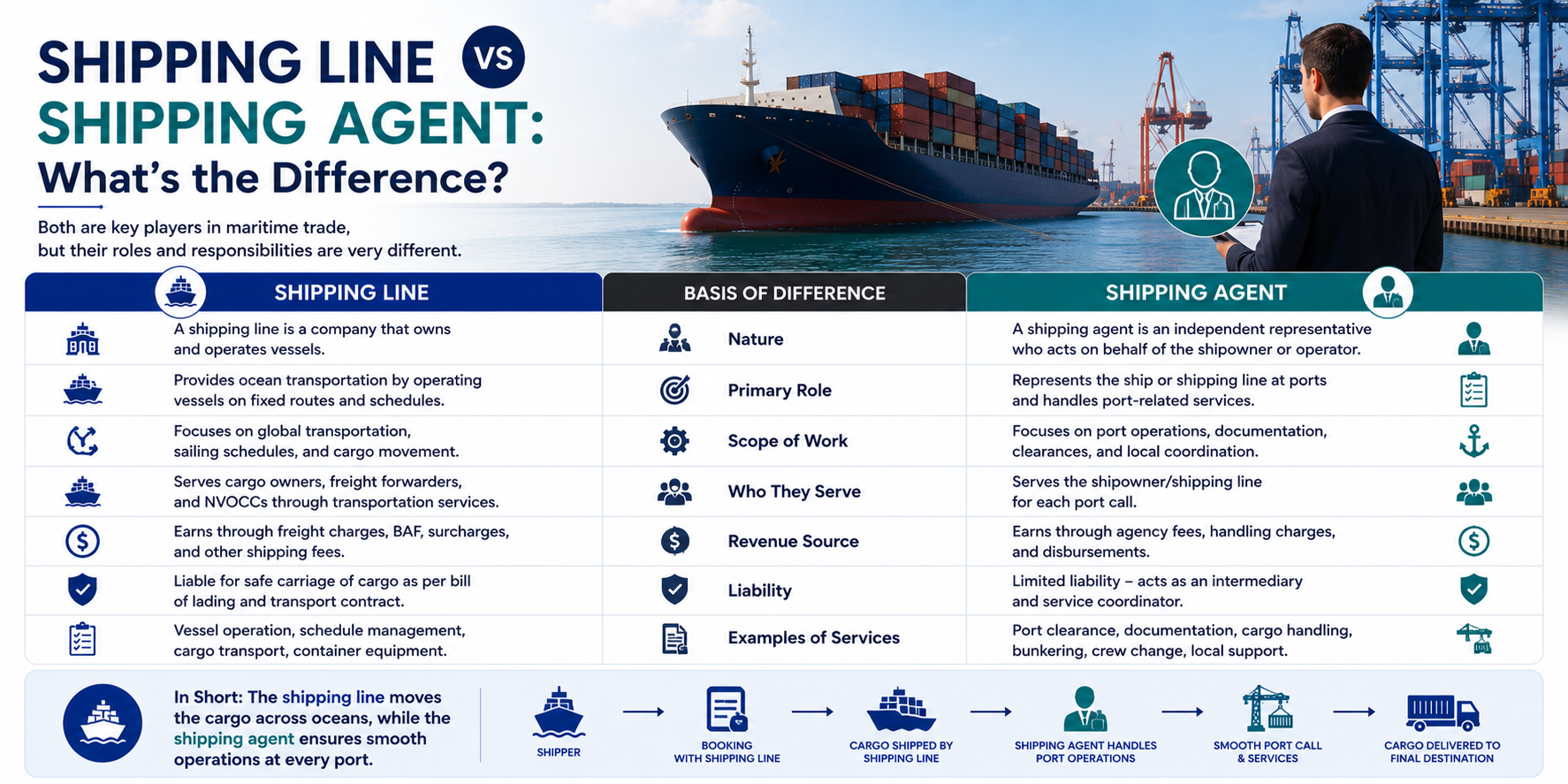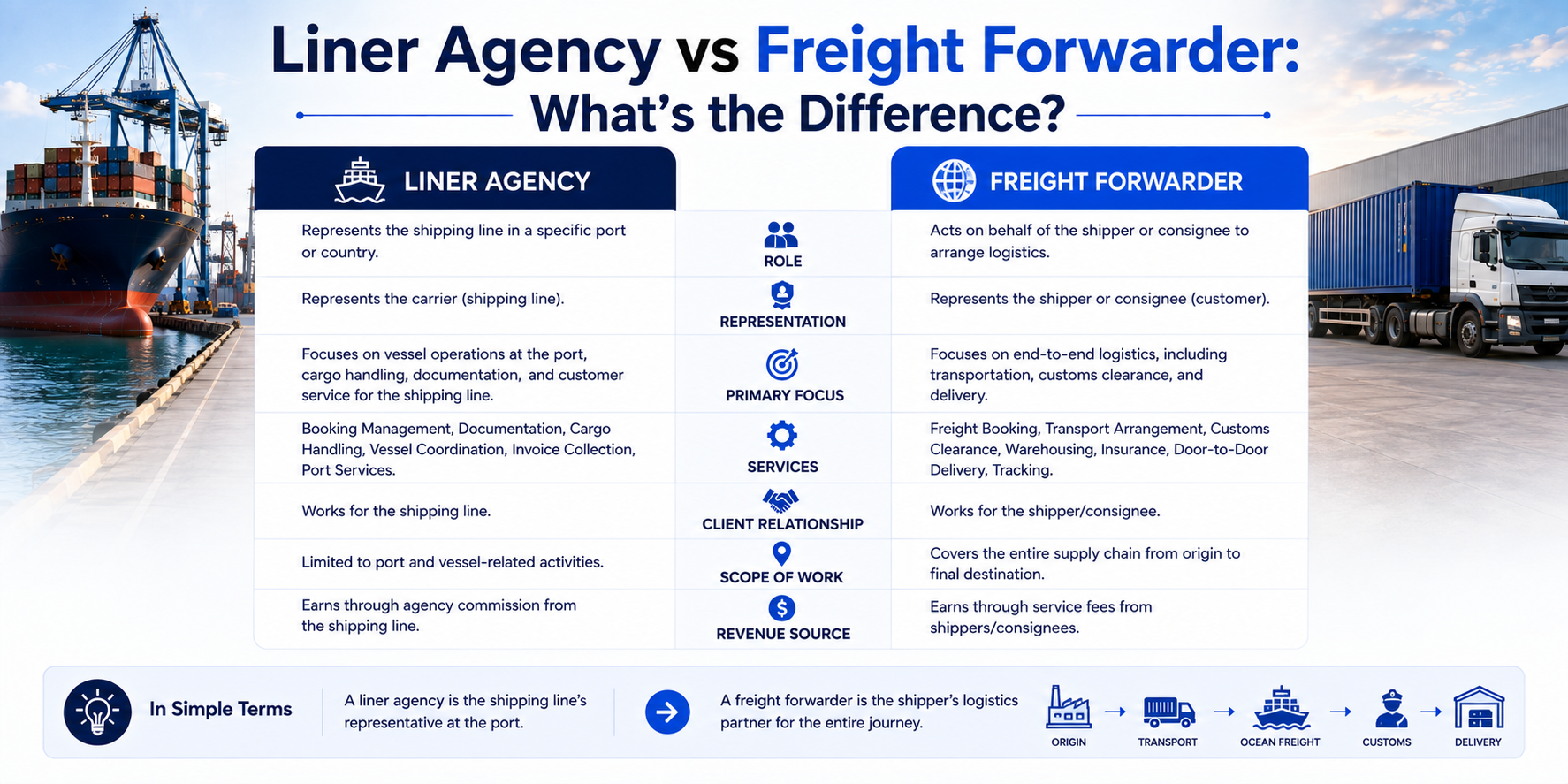
- A liner agency is the shipping line in every market where the line has no office of its own — commercially and operationally.
- The role splits in two: selling space and issuing documents, and running port calls and container fleets.
- Empty container control is the quiet discipline that separates a strong agency from a weak one.
- Agencies are measured on volume delivered, equipment turn time, documentation accuracy and freight collection.
A container line can operate a service calling ten ports and have offices in two of them. In the other eight it still needs to sell space, issue bills of lading, run port calls, chase empty containers and collect freight — every day, in the local language, under local rules.
It does that through a liner agency: a firm appointed to be the line in that market. To an exporter in Thane or a consignee in Mombasa, the agency is the carrier. Its staff quote the rates, its systems issue the documents, and its people answer when something goes wrong.
Two jobs under one appointment
Liner agency work divides cleanly, and the two halves attract very different people.
The commercial half
The agency markets the line's services locally: quoting rates, taking bookings, allocating the space the line has given the market, issuing bills of lading, and building the relationships with exporters and forwarders that produce repeat volume.
It also forecasts. The line decides where to deploy tonnage partly on what its agencies tell it the market will produce, so an agency that over-promises causes half-empty ships and one that under-promises causes rolled cargo. Honest forecasting is a commercial skill in its own right.
The operational half
The agency runs the line's physical presence: berthing and port calls, stevedore coordination, manifest filing and customs submissions, and the management of every container in the territory — full or empty, at a depot, on a truck, or sitting at a customer's yard past its free days.
Equipment control: the quiet discipline
Containers are expensive assets that earn nothing while idle. A trade lane that exports far more than it imports runs chronically short of empties; a lane that imports more accumulates them. Balancing this — repositioning boxes, managing depot stocks, chasing overdue units, deciding when to lease in — is a large part of what an agency does and almost none of what customers see.
When an agency loses track of its empties, exporters discover it as "no equipment available" in exactly the week they need to ship. Depot discipline is invisible right up until it is the only thing that matters.
What the agency handles across a shipment
- Enquiry and quotation Rate quoted from the line's tariff and local market conditions, with validity and surcharges stated.
- Booking and allocation Space confirmed against the market's allocation for that sailing; equipment reserved at a nominated depot.
- Empty release and stuffing Container released, hauled, loaded and sealed; seal number captured for the documents.
- Documentation Shipping instructions taken, draft bill of lading circulated for approval, VGM captured, manifest filed.
- Port call and loading Vessel worked, container loaded, sailing confirmed.
- Freight collection Invoice raised and collected under the agreed terms — the part owners care about most.
- Destination coordination Arrival notice, release against the bill of lading, and empty return to depot.
How lines judge their agencies
| Measure | What it tells the line | Good looks like |
|---|---|---|
| Volume vs allocation | Whether the market is being sold properly | Consistently filling the allocation without rolling cargo |
| Equipment turn time | How fast boxes cycle back into service | Short, predictable, with few overdue units |
| Documentation accuracy | Amendment volume and manifest errors | Very low correction rates |
| Freight collection | Cash actually recovered, and how quickly | Low outstanding, few disputes |
| Port productivity | How efficiently calls are run | Moves per hour at or above plan |
Allocation: how space gets shared out
A line does not simply sell space to whoever asks. Each market receives an allocation for each sailing — a share of the vessel's capacity, set centrally by the line's trade management according to what each trade contributes.
The agency's job is to fill that allocation profitably without over-committing. Accept more than the allocation and cargo gets rolled to the next sailing, which damages customer relationships and generates claims. Consistently fill less and the allocation shrinks at the next review, permanently reducing what the market can offer.
This has a direct consequence for shippers that is rarely explained. When an agency says space is tight, it is usually not a negotiating tactic — the allocation is genuinely finite for that week. Booking earlier is worth more than pushing on price, and customers with consistent, honest forecasts get protected in tight weeks because they are the ones who fill space in slack ones.
Documentation: the accuracy that decides everything downstream
An agency issues bills of lading on behalf of the carrier, and the accuracy of that document determines whether a shipper gets paid.
Shipping instructions arrive from the customer, are entered into the line's system, and a draft is circulated for approval before the original is released. That approval step exists precisely because amendments after issue are slow, chargeable, and sometimes impossible once a bank holds the document.
The errors that recur are mundane and consequential: a consignee name that does not match the letter of credit exactly, a goods description that disagrees with the commercial invoice, a port name entered in the wrong field, freight terms marked prepaid when the contract says collect. Each can cause a bank to reject the document set and delay payment by weeks.
This is why amendment rate is such a revealing metric. It measures whether an agency is checking work before it leaves the building, or correcting it afterwards at the customer's expense.
Choosing a liner agency, or choosing to ship through one
- Coverage that matches your lanes. An agency strong on the Gulf is not automatically strong on West Africa.
- Real allocation. Ask what space the agency actually holds in peak weeks, not what it can theoretically request.
- Equipment record. Ask how often bookings have been delayed by equipment in the last quarter.
- Documentation discipline. Ask about amendment rates — it is the single best proxy for operational care.
- Local reachability. Someone who answers in your time zone, in your language, with authority to decide.
- Financial standing. Agencies handle freight money and port funds. Solvency is not a detail.
What the agency does that customers never see
Three parts of the job consume enormous effort and generate no customer-facing output at all, which is exactly why they are the parts that quietly determine service quality.
Manifest filing. Every container on every sailing must be declared to customs at origin and destination, in the format each authority demands, before deadlines that vary by country. An error does not merely inconvenience one shipper — it can hold the vessel's entire manifest and delay release for every consignee on board.
Depot management. Empty containers must be inspected, cleaned, repaired and made available where exporters need them. A box returned with a damaged floor or a lingering odour cannot simply be re-issued. Deciding what to repair, what to retire and where to reposition is continuous work with real capital consequences.
Freight collection. Agencies commonly collect freight on the line's behalf and remit it. Chasing outstanding payment, resolving disputed invoices and managing credit exposure is unglamorous and it is where agency appointments are most often lost.
When things go wrong: what a good agency does differently
Disruption is the normal condition of shipping, so agencies should be judged on their handling of it rather than on smooth weeks.
When a sailing is blanked — cancelled by the line to manage capacity — a good agency contacts affected customers before they discover it themselves, with the next available option already identified and space provisionally held.
When equipment tightens, it tells customers early enough to bring bookings forward, rather than accepting bookings it knows it cannot support and rolling them later.
When a vessel is delayed, it recalculates the arrival honestly, including realistic berth waiting, instead of repeating an ETA it no longer believes. An optimistic ETA is worse than a pessimistic one, because the consignee books trucks and labour against it.
When cargo is damaged, it documents immediately — photographs, survey, exception noted on the delivery record — because a claim without contemporaneous evidence is a claim that fails.
Agency and forwarding on the same floor
Most forwarders buy from agencies. We sit on both sides — representing services and booking cargo onto them — and the practical benefit is information. When a sailing is going to blank, when equipment is about to tighten, when a port is slipping, we know it as an agency before we need it as a forwarder.
The most useful thing a forwarder can tell you is not what the schedule says. It is whether to believe it.
That is a difficult thing to buy from someone who is two steps removed from the vessel. It is straightforward when the desks are in the same room.
Shipping on a lane where the schedule matters? Send us the route and your cut-off — we will tell you what the service actually delivers, not just what it advertises.