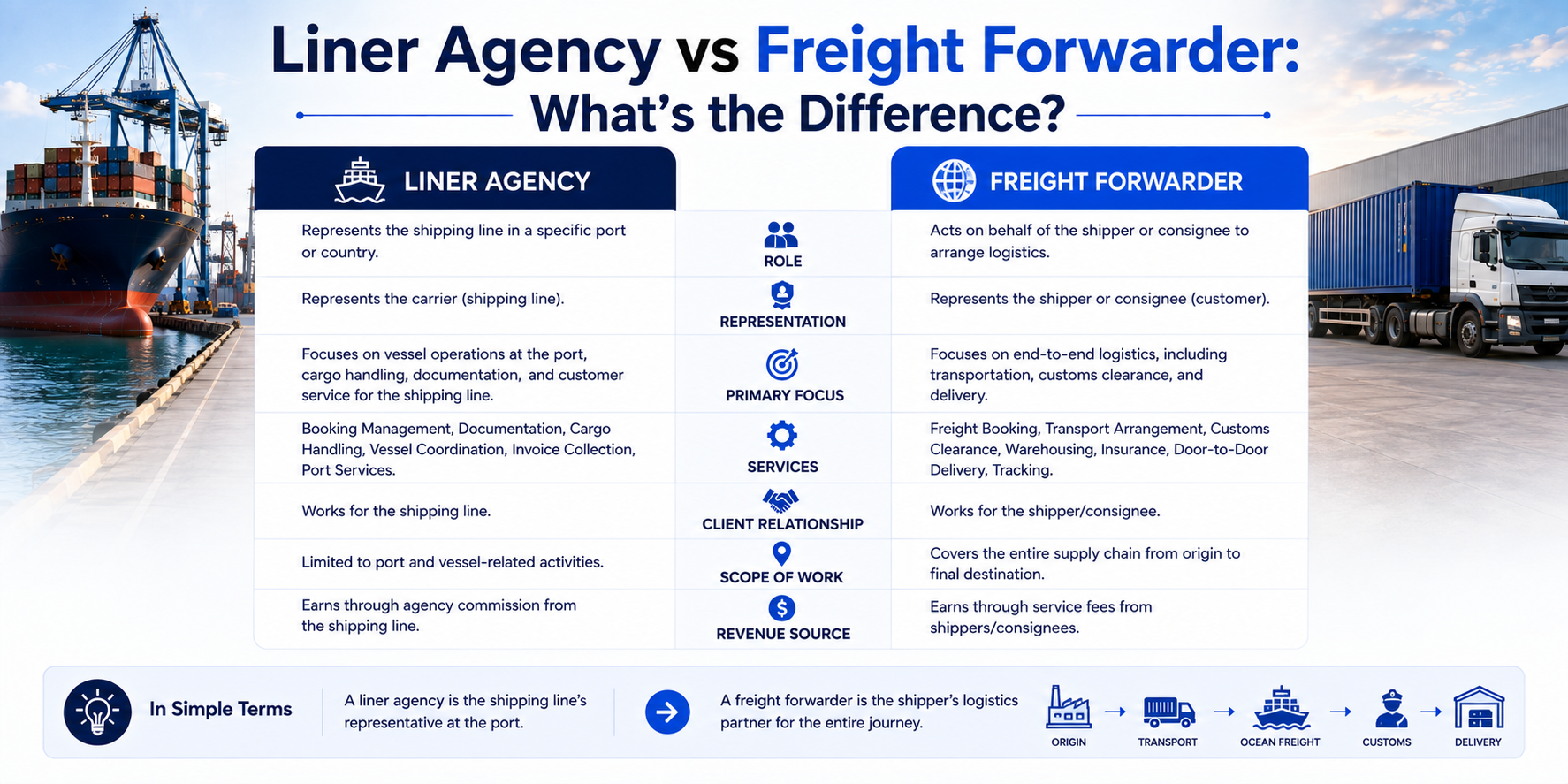
When it comes to international shipping, you've probably heard of 'liner agency' and 'freight forwarder'. They belong to the world shipping sector but have very different functions.
The liner agency is the agent of a shipping line and is responsible for the running of the vessel, port organisation, and local documentation. Freight forwarders primarily serve importers and exporters by arranging and organizing the shipment of goods from point A to point B.
It is crucial to understand the difference, since the selection of the right logistics partner can minimize delays, increase transparency of shipments, and ensure that your supply chain flows without a hitch.
What is a Liner Agency?
A shipping line's local representative is a liner agency. It runs the operations of the ships at the port and provides logistics support to make sure that the ships arrive on time to load or unload cargo and depart on schedule.
The liner agency, as opposed to a cargo-transporting agency, is the bridge between the shipping line, the port authorities, and the terminal operators, overseeing the operation of the vessels and coordinating port activities, as well as regulatory compliance.
Key Responsibilities
Responsibility
Purpose
Arrange for the vessels to arrive and depart in an orderly fashion
Ensure vessel schedules are maintained
Report to ports & terminals
To ensure smooth handling of cargo
Handle shipping documentation
Meet regulatory requirements
Assist customs and authorities
Maintain compliance
Schedule and manage shipments and unloadings
Reduce operational delays
Quick Insight: A liner agency maintains the ship's efficiency, and a freight forwarder maintains the cargo's efficiency.
What is a Freight Forwarder?
A freight forwarder is a logistics company that makes arrangements for the cargo to be transported from its point of origin to its final destination. A freight forwarder acts as a liaison between importers and exporters, organizing the logistics of transporting goods via sea, air, road or rail, ensuring efficient delivery.
A freight forwarder is not a liner agency, which owns neither ships nor operating ports. Rather, it collaborates with shipping lines, transport companies, customs brokers and warehouses to arrange the complete shipping procedure.
Key Responsibilities
Responsibility
Purpose
Make the optimal delivery route selection
Minimize the time and expenses associated with transportation and shipping
Book cargo space
Install space securement, such as shipping lines or carriers
Coordinate inland transportation
Transport goods to and from ports
Prepare shipping documents
Make sure that you have smooth shipment processing
Coordinate customs clearance
Help with import and export compliance
Track shipments
Provide shipment visibility and updates
Arrange final delivery
Complete the cargo journey
A freight forwarder, who operates between multiple logistics partners, is responsible for the whole process of goods transportation from pickup to delivery.
Why Businesses Choose a Freight Forwarder
There are several carriers, customs, paperwork, and types of transportation involved in managing international shipments. A freight forwarder can make this easier by managing all aspects of the shipment, from start to finish, and ultimately help businesses save time, minimise delays, and streamline the supply chain.
Liner Agency vs Freight Forwarder: At a Glance
Feature
Liner Agency
Freight Forwarder
Represents
Shipping line
A person who imports, exports, or serves as a cargo owner
Primary Focus
Vessel operations and port coordination, including cargo and passenger traffic and collections
The transportation and logistics of cargo was a key area of focus
Main Responsibility
Arranging & controlling vessel calls & port operations
Planning for movement of goods and materials
Customers
Shipping lines
Businesses, manufacturers, exporters and importers
Handles Cargo Booking
Aids delivery of shipping goods
A cargo space for books.A space for the books, which is an abbreviation for cargo space
Coordinates Port Operations
Yes
No
Arranges Inland Transportation
No
Yes
Manages End-to-End Shipment
No
Yes
Works With
Ports, terminals, customs houses and shipping lines
Shipping lines, transport providers, warehouses and customs brokers
Goal
Ensure smooth operations of the vessel
Maintain smooth flow of goods
In a nutshell, a liner agency is responsible for moving the boat efficiently through the port, and a freight forwarder is responsible for moving your cargo efficiently through the supply chain.
How Liner Agency and Freight Forwarders work together?
While there are distinct roles for the liner agencies and freight forwarders, many times both are used in conjunction to facilitate shipments across the supply chain.
Let's take an example of an international shipment; here's how it works:
Stage
Responsible Party
Pick up of goods from the shipper
Freight Forwarder
Interport transport to the port
Freight Forwarder
This is a space booking program for the cargo shipping company
Freight Forwarder
Arrival of vessels and coordination with ports
Liner Agency
Loading of goods into the ship
Liner Agency
Vessel leaves for destination
Shipping Line
Upon arrival of cargo, manage the port handling
Liner Agency
Movement in the country to the consignee
Freight Forwarder
For instance, an exporter sends engineering goods to the UAE from India. The freight forwarder is responsible for picking, documenting, booking of cargo, and delivery. Meanwhile, the liner agency is responsible for operating the ship at both ports and ensuring that the cargo is loaded and discharged on schedule.
The Most Frequent Problems while Shipping across International Lines
Shipping companies, ports, customs, transport companies, and cargo owners are some of the entities involved in international shipping. If they are not coordinated properly, deliveries may be delayed, unexpected expenses may be incurred, and operations may be disrupted.
These challenges are addressed by both the liner industry and freight forwarders.
Common Challenge
Who Helps?
How They Help
Scheduling of ships, port coordination
Liner Agency
Manages ships' entry and exit and terminal operations
Cargo booking and shipment planning
Freight Forwarder
Saves cargo space and estimates the best shipping route
Shipping documentation
Both
Provides accurate records to facilitate cargo movement
Customs and regulatory compliance
Freight Forwarder
Arranges customs clearance through licensed customs brokers
Communication problems and delays in shipment
Both
Offer operational reports and liaise with appropriate parties
Quick Insight: The cooperation of the liner agencies and freight forwarders, with their respective specialities, is an effective way to streamline international shipping.
Frequently Asked Questions
1. What is the difference between a liner agency and a freight forwarder?
A shipping line's agents are referred to as liner agents and are responsible for the operations, port arrangements, and documentation of the line. A freight forwarder is an agent for importers or exporters who acts as a liaison for shipping and receiving goods from one place to another.
2. Is there any method for a freight forwarder to work with a liner agency?
Yes. Liner agencies are commonly used by freight forwarders when arranging shipments with shipping lines. Freight Forwarder: In charge of the cargo; Liner Agency: In charge of the shipping line's operations in the port. 3. Does a liner agency carry freight?
No. A liner agency is not a freight carrier. It is expected to take charge of vessel operations, liaise with ports/terminals, and provide assistance to the shipping line through each port call.
4. Are the ships owned by a freight forwarder?
In most cases, no, freight forwarders do not own the mode of transport; they are there to work with the shipping lines, airlines, trucking companies, and the rail operators.
5. With whom should importers and exporters go?
Most importers and exporters deal with a freight forwarder since they are responsible for booking the cargo, arranging transportation, co-ordinating with the customs house, and handling delivery from origin to destination.
6. Will there be an agent/liner company that can offer both services?
Yes. A few logistics firms provide both services, enabling a customer to take advantage of a single service provider for their vessel operations and cargo management services.
7. Do you have to have a freight contract to charter?
No. A local shipping line representative is called a liner agency. It supervises the operations of the shipping line in certain ports without owning and operating the ships.
8. What is the significance of knowing the difference?
Knowing the difference gives businesses a better idea of which logistics partner to select, how best to plan shipments, minimize delays, and ensure international shipping goes more smoothly.
Selecting the Appropriate Logistics Partner
Both liner agencies and freight forwarders are important actors in international shipping but have different functions within the supply chain.
A liner agency represents the shipping company and provides assistance in maintaining the smooth running of the vessels, coordinating port activities, and complying with the relevant regulations. A freight forwarder acts as a cargo owner's agent, handling everything from arrangement and cargo booking to customs clearance and last-mile delivery.
Having insights into these separate roles enables businesses to select a suitable logistics partner, optimize their operations, and reduce delays during the shipping procedure.
For shipping lines, finding a port representative who can deliver the reliability they need is essential, while for businesses, choosing a partner that can manage all aspects of the cargo journey is crucial for maintaining a smooth supply chain.
Tags- Freight Forwarding
- Freight Forwarder
- Liner Agencies
- Liner Agencies
- Freight Forwarder
- Shipping Agents
- Liner Agencies
- Shipping Line
- Liner Agencies
Let's move your world — together
Logistics insight, market updates, and the occasional story from the field — straight to your inbox. No spam, just signal.
Or request a shipping quote
End-to-end freight forwarding, NVOCC, project cargo, warehousing and customs — connecting your world since 2003.
Solutions
Company
Investors
Get in touch
Some keep the site working; the optional ones tell us which pages are useful. You choose. Read our privacy policy.