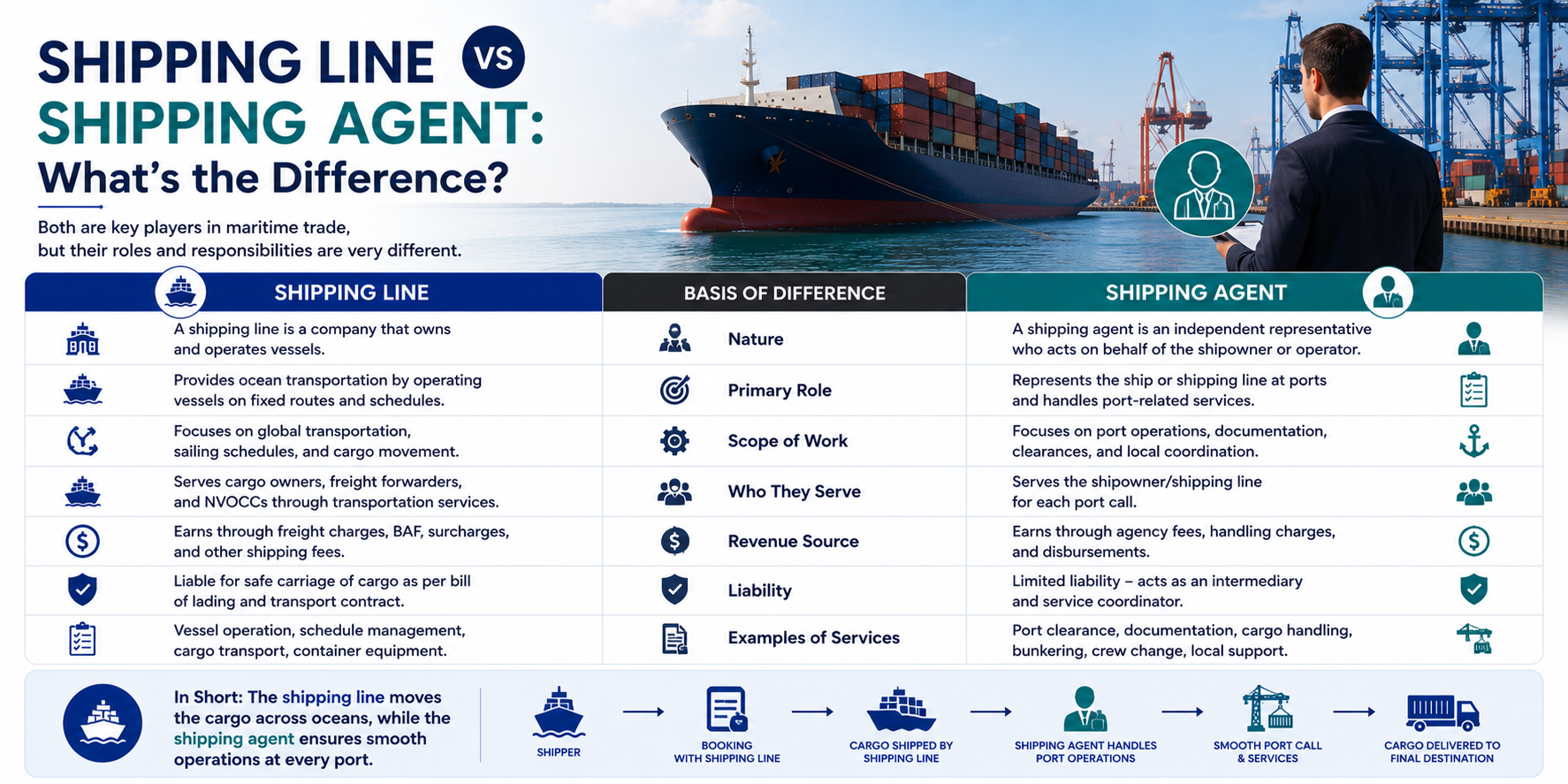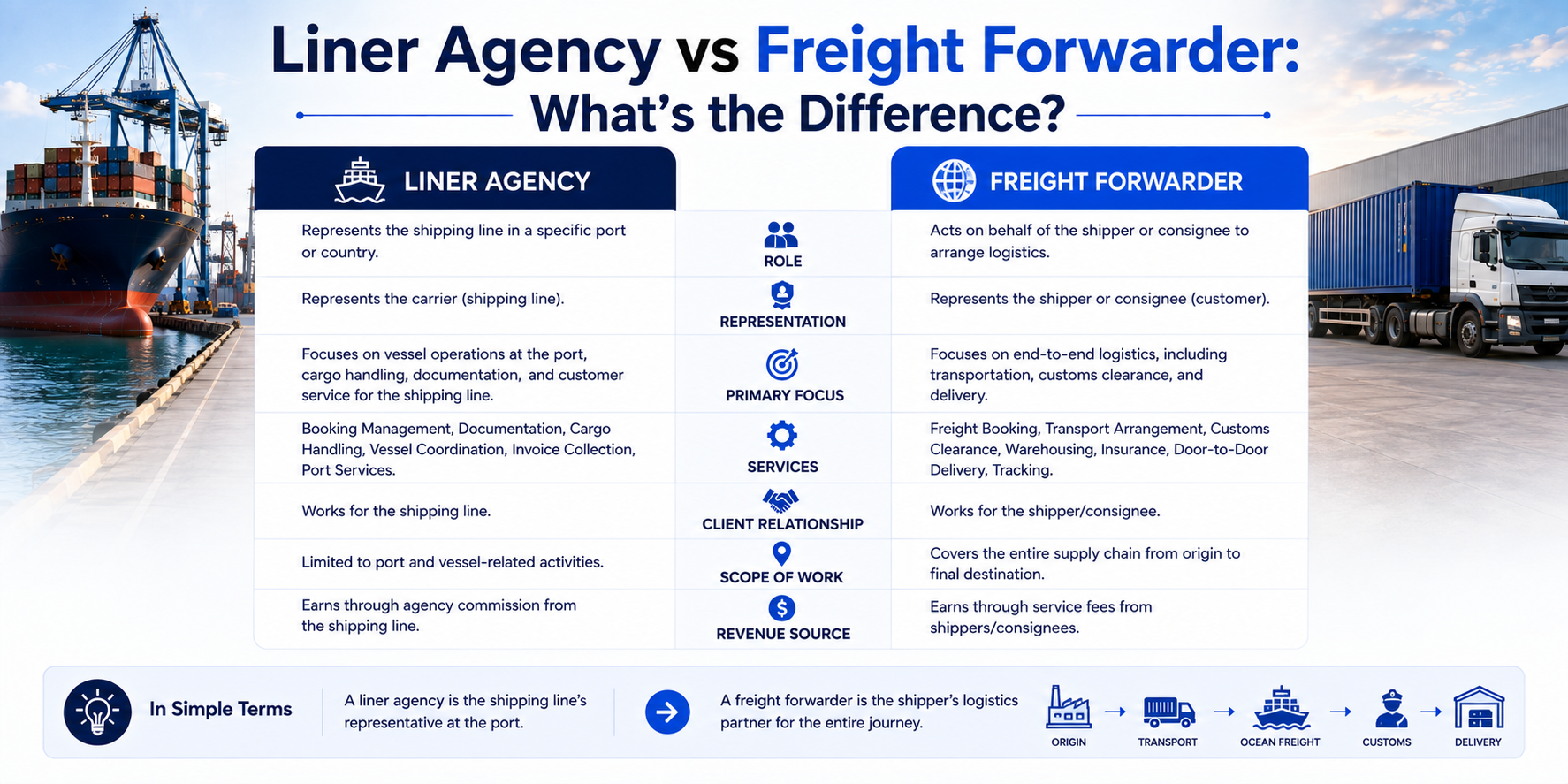
- A shipping agent represents the vessel and its owner in port. A freight forwarder represents the cargo and its owner. They are different jobs with different clients.
- Most of the value is delivered before the ship arrives — filings, berth booking and service ordering that decide whether the call runs to schedule.
- Port time is the most expensive time a vessel has. An agent who saves half a day has usually paid for the whole call.
- The disbursement account is where agents are judged: every rupee itemised, reconciled and closed quickly.
A ship arriving in a foreign port is, commercially speaking, blind and mute. It has no office there, no bank account, no relationship with the terminal, no standing with customs or immigration. It cannot order fuel, book a berth, arrange a crew change or pay a port bill. Everything that has to happen ashore has to be done by somebody who is already there.
That somebody is the shipping agent — the vessel's legal and commercial representative in port, appointed by the shipowner, the charterer or the operator to act on their behalf from the moment a call is planned until the last invoice is settled.
What a shipping agent actually is
The role is often described vaguely as "handling the ship's paperwork", which undersells it considerably. An agent holds a mandate: within the scope of the appointment, the agent's signature commits the principal. Ordering a tug, accepting a berth window, signing a statement of facts — these are decisions with money attached, made on the owner's behalf, often at three in the morning without time to consult anyone.
That is why appointing an agent is a question of trust rather than price. The cheapest agency fee in a port is rarely the cheapest port call.
Agent, forwarder, broker: who represents whom
These three roles are routinely confused, including by people who work in the trade. The distinction is simple once you ask a single question: whose interest does this party represent?
| Role | Represents | Core job | Paid by |
|---|---|---|---|
| Shipping agent | The vessel / owner | Everything the ship needs while it is in port | Owner or charterer |
| Freight forwarder | The cargo / shipper | Moving goods door to door across modes and borders | Shipper or consignee |
| Ship broker | Buyer or seller of tonnage | Fixing charters and sale-and-purchase deals | Commission on the fixture |
| Customs house agent | The importer / exporter | Declaring and clearing goods with customs | Cargo owner |
A single group can hold more than one of these mandates — we do — but each is exercised for a different client, and a serious operator keeps the walls between them clear.
The types of agency appointment
Not every agency appointment covers the same ground. The four you will meet most often:
- Liner agent Represents a shipping line on a fixed service in a market where the line has no office. Sells space, issues bills of lading and runs the line's port calls and container fleet locally.
- Port agent Appointed for a single call, usually on tramp or bulk vessels. Handles that one arrival, working period and departure.
- Protecting agent Appointed by an owner to watch over a call where the charterer has nominated a different agent — a second pair of eyes on time and cost.
- Husbandry agent Deals with the ship and crew rather than the cargo: medical care, crew changes, spares, provisions, repairs, bunkers.
The three phases of a port call
An agent's work divides cleanly into what happens before the ship arrives, what happens while it works, and what happens after it sails. The first phase determines most of the outcome.
Before arrival
The agent files the vessel's pre-arrival notice, crew and passenger lists, cargo declarations, dangerous-goods manifests and health documents with the port, customs and immigration. Berth and pilot bookings go in. Stevedores are ordered against the stowage plan. Bunkers, fresh water, provisions and any spares are arranged to meet the ship, not to be chased once it is alongside.
Dangerous goods deserve special mention: their permits are almost always the slowest item in the file, and starting them late is one of the most common self-inflicted delays in the business.
A berth that is confirmed, a gang that is booked and a document set that is already accepted cannot be created once the vessel is at anchor. Almost every hour lost in port was lost days earlier, at a desk.
While the ship works
Once alongside, the agent coordinates cargo operations with the terminal and monitors the rate of work — moves per hour is the number that decides whether the ship sails on time. Alongside that run crew changes, immigration formalities, medical cases, class and P&I surveys, repairs, and the endless small requests a working ship generates.
The agent also keeps the statement of facts: a timed record of every event from arrival to departure. On chartered vessels this document decides laytime and demurrage, so an inaccurate one is not a clerical problem — it is a commercial loss.
After departure
Outward clearance is obtained, the statement of facts is finalised, and the disbursement account is prepared: a complete, itemised reconciliation of every cost incurred against the funds the owner advanced. Owners judge agencies on this document more than any other. A clean account closed in days signals control; a vague one closed in months signals the opposite.
What good agency work is worth
The economics are unsentimental. A vessel's daily operating cost runs from a few thousand dollars for a small coaster to tens of thousands for a large container ship, and none of it stops while the ship sits idle.
The agent's real product is not paperwork. It is time — and in shipping, time is the only cost that cannot be recovered.
How to choose a shipping agent
Whether you are an owner appointing for a single call or a line appointing for a market, the same things separate a good agency from a cheap one.
- Local standing. Does the agency have working relationships with the terminal, the pilots and the authorities — or is it starting every conversation cold?
- Genuine 24/7 response. Not a duty phone that goes to voicemail. Someone who can decide, at night, without escalating.
- Pre-arrival discipline. Ask how many days before ETA they file. The answer tells you most of what you need to know.
- Disbursement account turnaround. Ask for their average. Weeks is normal; days is good; months is a warning.
- Transparency on third-party costs. Port dues, towage and stevedoring should be passed through with supporting invoices, not bundled.
- Depth beyond the ship. An agency that also handles cargo, customs and inland transport can solve problems that a pure agency has to hand off.
Where agency meets cargo
For a cargo owner, the agent is usually invisible — you deal with your forwarder, and the forwarder deals with the line, and the line's agent deals with the ship. But the quality of that agent still reaches you. A call that runs long delays the vessel's next port. A statement of facts that is wrong triggers a demurrage claim that eventually lands on a cargo interest. Documentation filed late at the load port becomes an amendment problem at the discharge port.
This is why we operate both sides of the relationship at S J Logistics. We represent vessels in port and we represent cargo across borders, which means when something goes wrong at the berth, the people who need to fix it and the people who need to know about it are in the same building. Nothing waits for a handover between companies that have never met.
How agents are paid, and why it confuses people
An agency's own fee is usually the smallest line on the disbursement account. The agent collects funds in advance from the principal, pays port dues, pilotage, towage, mooring, stevedoring and every other third-party service out of that advance, and charges an agency fee for the coordination itself.
This structure causes two recurring misunderstandings. The first is that owners sometimes compare agencies on the fee alone, when the fee might be five percent of what the call actually costs — and a weak agency can lose far more than the entire fee in a single extra day alongside. The second is that pass-through costs get treated as agency revenue. They are not. A well-run account shows every third-party charge with its supporting invoice attached, and the agency's own earnings clearly separated.
Where agencies do differ commercially is in what the fee includes. Attendance at every shift, or only at arrival and departure? Crew changes handled, or billed as an extra? Out-of-hours response, or office hours with a surcharge? These are worth settling in writing before the appointment, not discovering on the account.
What goes wrong, and what it costs
Almost every serious problem in a port call belongs to one of four categories, and knowing them is the fastest way to judge whether an agency is protecting you.
Documentation rejected on arrival. A crew list that disagrees with the immigration record, a manifest that does not match the stowage, a certificate that expired in transit. The vessel waits, sometimes at anchor, until it is corrected. Almost always preventable by filing early enough to receive the rejection while there is still time.
Berth lost. Terminal line-ups shift constantly. An agency that confirms a window three days out and never checks again may find the slot gone. Reconfirmation is dull, unglamorous work, and it is the single most valuable habit an agency can have.
Services not ready. Bunkers ordered late, a gang short of men, a crane unavailable, a surveyor who cannot attend. Each turns working time into waiting time while the vessel's daily cost continues.
Disputes created by poor records. An imprecise statement of facts is not discovered as a problem during the call. It is discovered weeks later, when a demurrage claim arrives and the log cannot support the owner's position.
The short version
A shipping agent is the ship's presence ashore: filing before arrival, coordinating while alongside, and accounting after departure. The job is judged on hours saved and rupees reconciled, and almost all of it is won or lost in the days before the vessel appears on the horizon.
If you are moving cargo through Indian ports and want the ship side and the cargo side handled by one accountable team, talk to our operations desk — tell us the vessel, the port and the dates, and we will tell you exactly what the call needs.