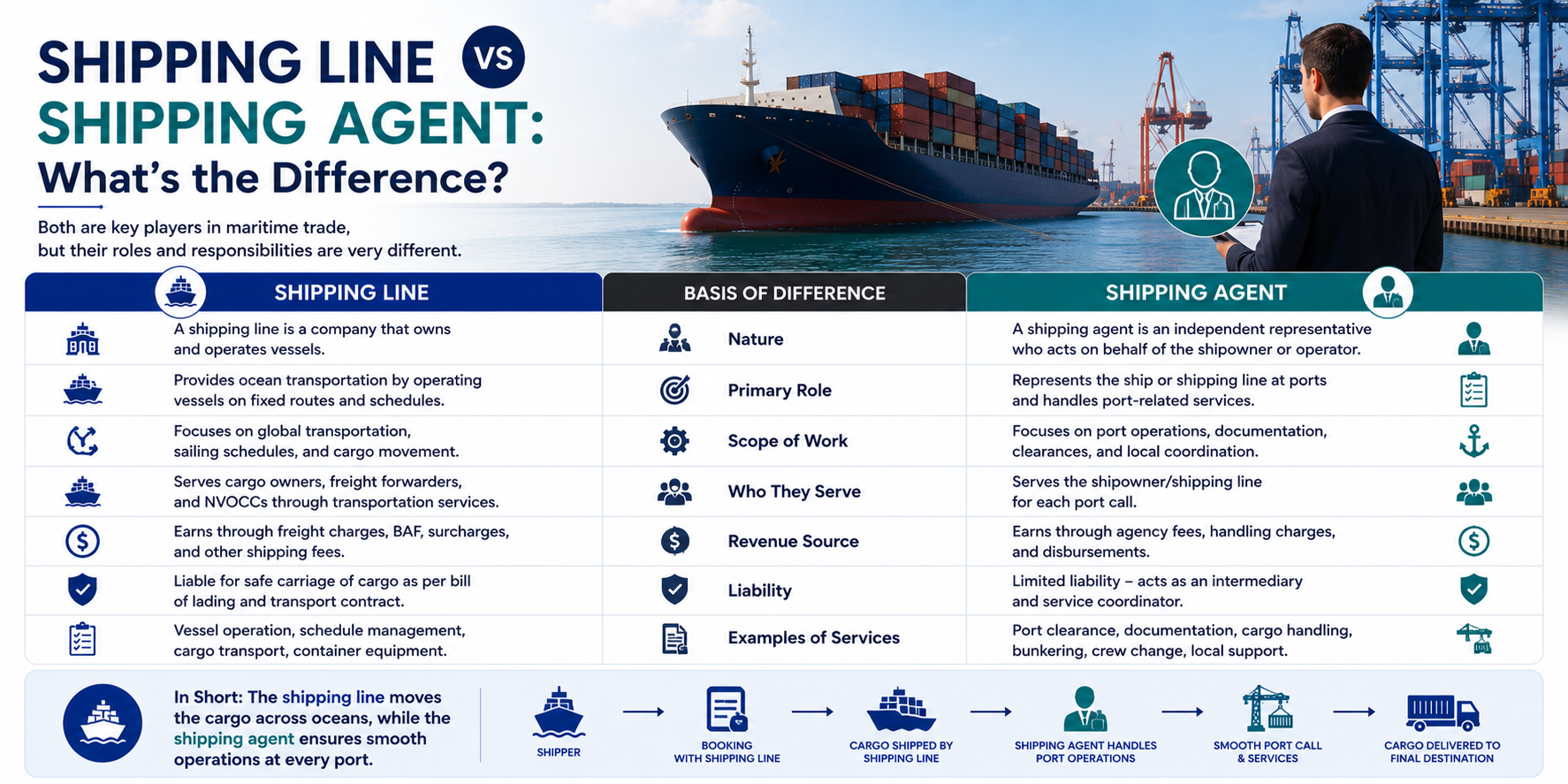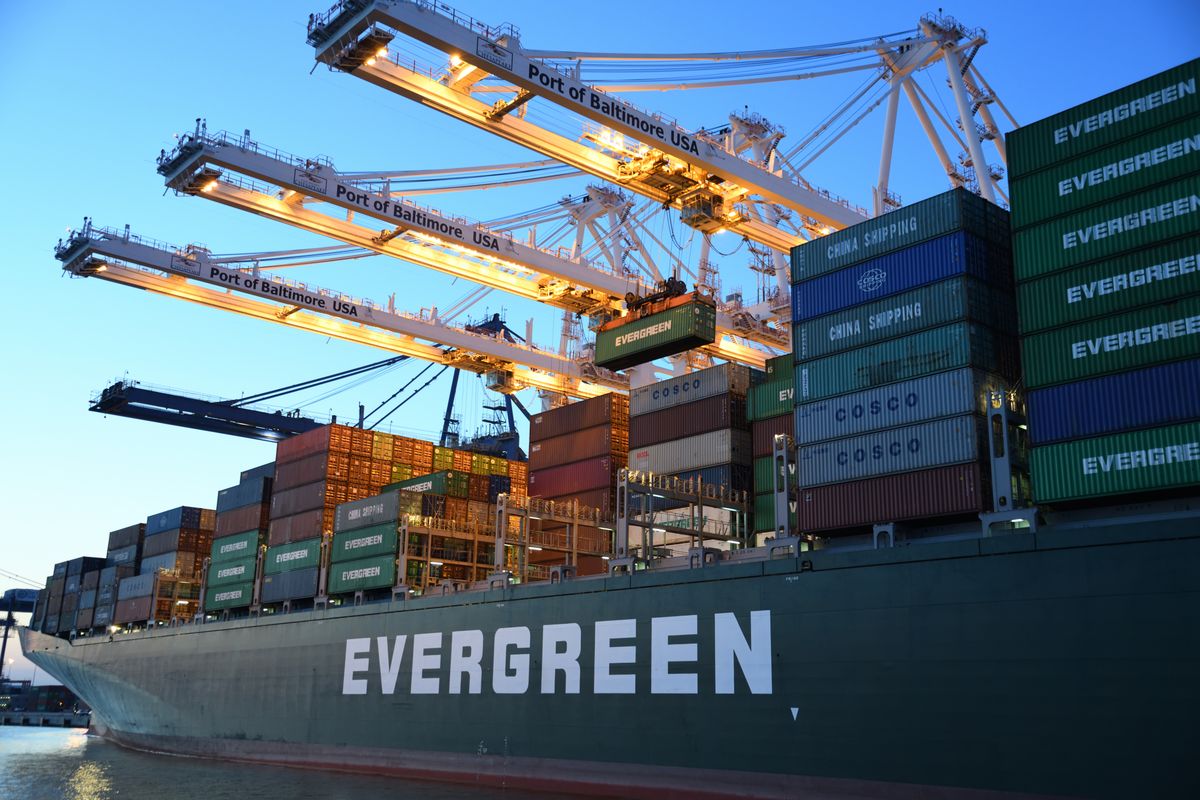
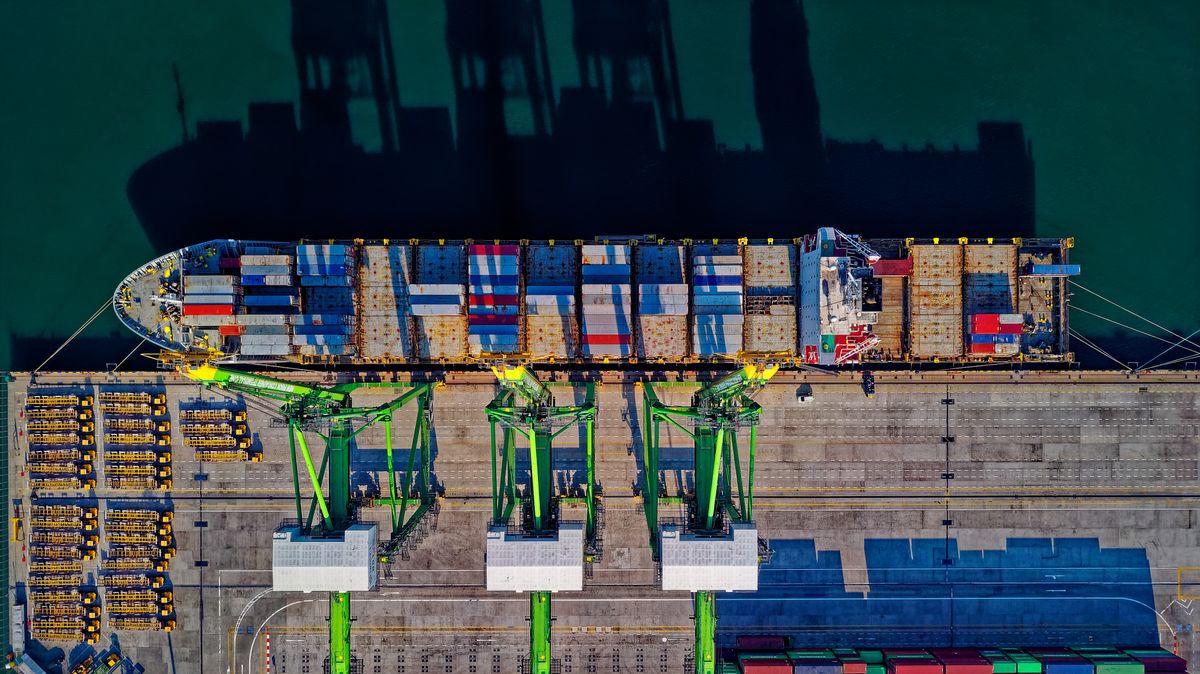
- A shipping line runs vessels on fixed rotations to published schedules — a bus service for cargo, not a taxi.
- The line sells port-to-port carriage. Pickup, customs and delivery are arranged around it by a forwarder or NVOCC.
- Capacity per sailing is fixed, so when demand rises, space matters more than price.
- A booking without an empty container allocated at the right depot is only half a booking.
Most of what the world buys arrives on a shipping line, and almost nobody outside the trade could describe how one works. The mental model people carry — you pay a shipping company, they take your goods somewhere — is close enough to be useless, because it hides the two things that actually govern your shipment: the schedule and the space.
Here is the working model.
A shipping line is a scheduled service
A line operates vessels on a rotation: a fixed sequence of ports, called in the same order, at the same interval, week after week. A typical India–Europe service might call Nhava Sheva, Mundra, Jebel Ali, Jeddah, Rotterdam, Hamburg, Antwerp, then head back east.
To keep a weekly departure on a rotation that takes eight weeks to complete, the line deploys eight vessels on that string. Your container joins the loop at one port and leaves it at another. It is a bus route, and the timetable is the product.
Why cut-off times rule an exporter's calendar
Because departures are weekly rather than continuous, everything upstream is organised around a deadline. Each sailing has a documentation cut-off, a gate-in cut-off and a VGM (verified gross mass) cut-off, and they fall on different days.
Missing a cut-off by an hour usually costs a week, and that week is not just transit — it is a week of extra financing on the goods, a week later into the buyer's stock cycle, and sometimes a letter of credit expiring.
Take the gate-in cut-off, subtract terminal queue time, subtract the road leg, subtract stuffing, subtract document preparation. That is your real production deadline — and it is usually several days earlier than exporters assume.
What the line does and does not do
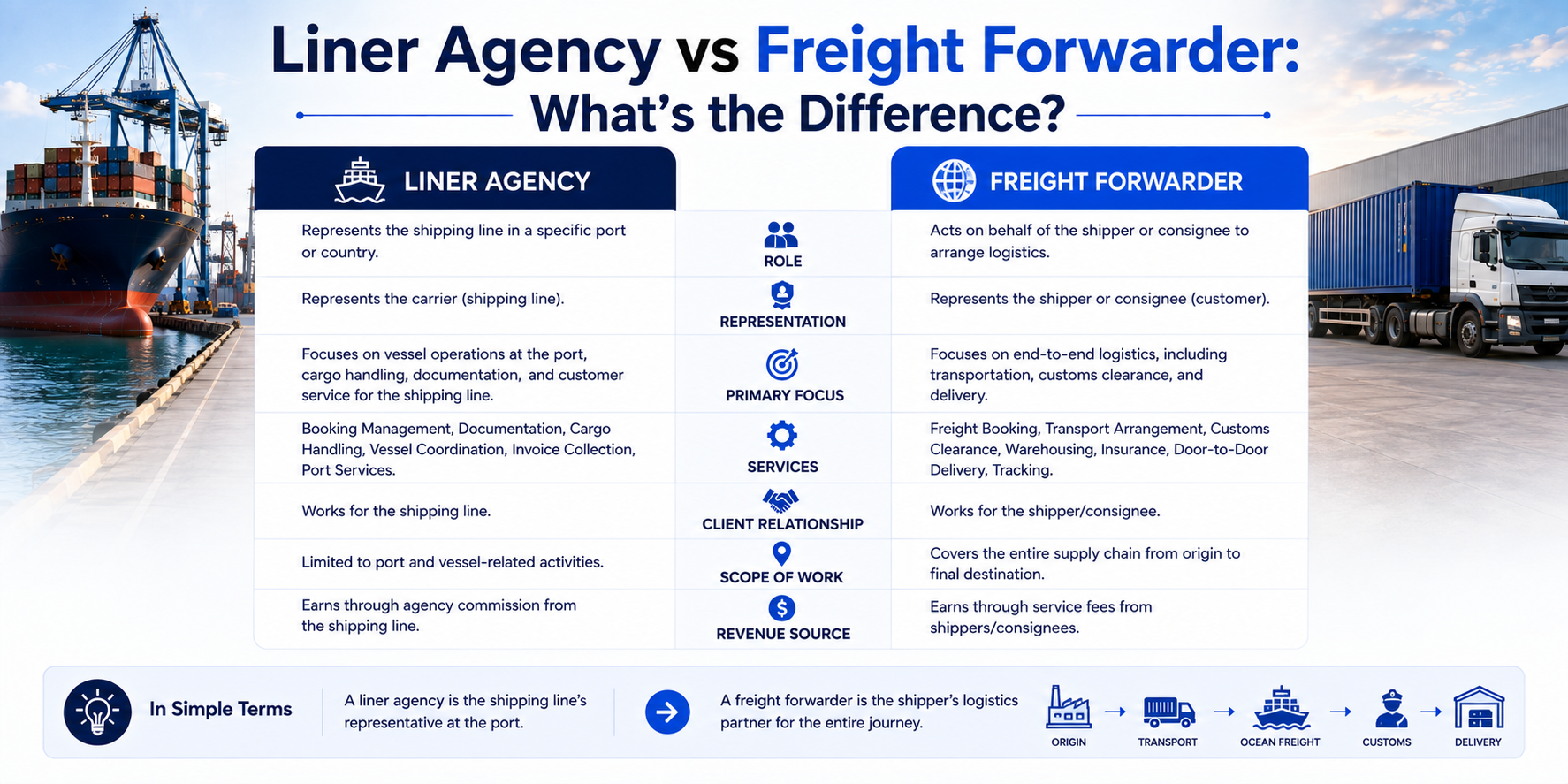
A line operates vessels and containers and sells space between ports. It does not collect from your factory, clear your customs, or deliver to your buyer's door. Its bill of lading covers port to port; everything on either side is arranged separately.
| Shipping line | Freight forwarder | NVOCC | |
|---|---|---|---|
| Owns vessels | Yes | No | No |
| Issues its own B/L | Yes (master) | Usually not | Yes (house) |
| Acts as carrier | Yes | No — acts as agent | Yes |
| Arranges door-to-door | Sometimes, at a price | Yes, its core job | Yes |
| Handles your customs | No | Yes, via a CHA | Yes |
This is why most shippers do not book directly with a line even when they could. The line sells one leg of a journey that has at least five.
Alliances: why your box may sail on another line's ship
Major container lines operate in alliances, sharing vessel capacity across jointly operated services. You book with one line and your container sails on a vessel operated by another. This is normal, contractual and invisible in your paperwork — your contract remains with the line whose bill of lading you hold.
It matters for one practical reason: it explains why a vessel name on a booking can change without your service changing, and why schedule reliability tends to move together across lines on the same trade.
How ocean freight rates are actually built
The headline rate is rarely the whole cost. A quotation typically assembles from a base ocean freight plus a stack of surcharges, each of which moves independently.
| Component | What it covers | Behaviour |
|---|---|---|
| Ocean freight | The sea carriage itself | Moves with supply and demand, sometimes weekly |
| BAF / fuel | Bunker fuel cost adjustment | Tracks fuel prices with a lag |
| THC | Terminal handling at each end | Fairly stable, set locally |
| Documentation | B/L issuance and processing | Fixed per shipment |
| Seasonal / peak | Demand surcharges in peak season | Appears and disappears |
| Congestion | Applied when a port is badly delayed | Event driven |
When comparing quotations, compare the all-in landed figure. A low ocean rate with an aggressive surcharge structure regularly lands higher than a sensible all-in number.
Equipment: the half of the booking everyone forgets
A booking gives you space on a vessel. It does not automatically give you a container in the right condition at the right depot at the right time — and without that, the space is worthless.
Equipment availability moves with trade imbalance. On lanes that export far more than they import, empties are chronically short, and in tight weeks a forwarder who can actually produce a clean, cargo-worthy box is worth more than one quoting twenty dollars less.
In a soft market you buy rates. In a tight market you buy space and equipment — and the difference between the two is the difference between shipping and waiting.
From booking to sailing, step by step
- Booking placed and confirmed Lane, service, vessel and equipment type agreed; booking number issued.
- Empty release The container is released at a nominated depot and hauled to the stuffing point.
- Stuffing and sealing Cargo loaded, secured and sealed; the seal number goes onto the documents.
- Documentation and VGM Shipping bill filed, B/L instructions submitted, verified gross mass declared before cut-off.
- Gate-in The box enters the terminal ahead of the deadline and is staged for loading.
- Loading and sailing Container loaded to the confirmed vessel; sailing confirmation issued.
- Transit and arrival Tracked through any transhipment to the discharge port.
- Release and delivery Cargo cleared at destination and delivered against the bill of lading.
Transhipment: why your box may change ships
Not every port pair has a direct service. On thinner lanes your container is carried to a hub — Colombo, Singapore, Jebel Ali, Salalah — discharged, and reloaded onto a second vessel heading to the final destination. This is transhipment, and it is entirely normal.
It is also where transit times stretch. A connection missed at the hub costs a week, and the extra handling adds a small but real damage risk. Two things are worth asking before you book: is the routing direct or transhipped, and if transhipped, what is the connection window at the hub? A booking with a six-hour connection is technically valid and practically fragile.
Direct services cost more per container and are usually worth it when the delivery date carries a penalty. Transhipped routings are cheaper and perfectly sensible when the schedule has slack. The mistake is not choosing one — it is not knowing which one you bought.
Free days, demurrage and detention
Three charges catch out more first-time shippers than anything else in ocean freight, largely because two of them sound identical.
Free days are the days allowed at destination before charges start — sometimes as few as three, sometimes fourteen on a negotiated contract. Demurrage accrues while a full container sits inside the terminal beyond those free days. Detention accrues once you have taken the container out of the terminal and are holding it at your premises beyond the allowance.
Both are charged per container per day, both escalate on a sliding scale, and both are entirely avoidable with planning. The most common cause is not congestion — it is import documents that were not ready when the vessel arrived. Negotiating free days at booking, rather than requesting a waiver afterwards, is the difference between a controlled cost and an argument.
Schedule reliability: read the promise carefully
Published schedules are plans, not guarantees. Weather, congestion, industrial action and blank sailings — where a line cancels a scheduled departure to manage capacity — all reshuffle rotations.
What separates good partners here is not whether disruption happens; it is how fast you hear about it and what alternative arrives with the news. A forwarder who tells you on Tuesday that Friday's sailing is blanked, and has already secured space on the next one, is doing the job.
Reading a bill of lading without panicking
The bill of lading is the document the whole system turns on, and it does three jobs at once, which is why it confuses people.
It is a receipt, evidencing that the carrier took the goods in the condition described. It is evidence of the contract of carriage, incorporating the carrier's terms. And when issued as a negotiable original, it is a document of title — whoever holds it controls the cargo, which is why banks accept it as security under letters of credit.
That third function explains the paperwork anxiety around it. A negotiable original is effectively the cargo in paper form. Lose it and release becomes slow and expensive, usually requiring a bank-backed letter of indemnity.
Two practical distinctions matter. A clean bill carries no adverse remark about the goods' condition; a claused one records damage or discrepancy noted at loading, and banks routinely reject claused bills under letters of credit. A straight bill consigns to a named party and is not negotiable; an order bill is negotiable by endorsement. Choosing the wrong one for your payment terms creates problems that surface only when payment is due.
Always check the draft before issue. Consignee spelling, description of goods, marks and numbers, port names and the freight-prepaid or freight-collect notation should all match your invoice and letter of credit exactly. Amendments after issue are possible but slow, and when a bank is involved, expensive.
Where an NVOCC changes the picture
As a licensed NVOCC and registered Multimodal Transport Operator, we contract with shippers as a carrier: our own house bills of lading, our own contracted space with the lines, our own destination network. You get the reliability of the liner system without having to manage its complexity — one document, one counterparty, one number to call.
If you are shipping out of India and want to know what your lane really costs and how reliable it really is, send us the route. We will quote the all-in figure and tell you honestly what the schedule is worth.