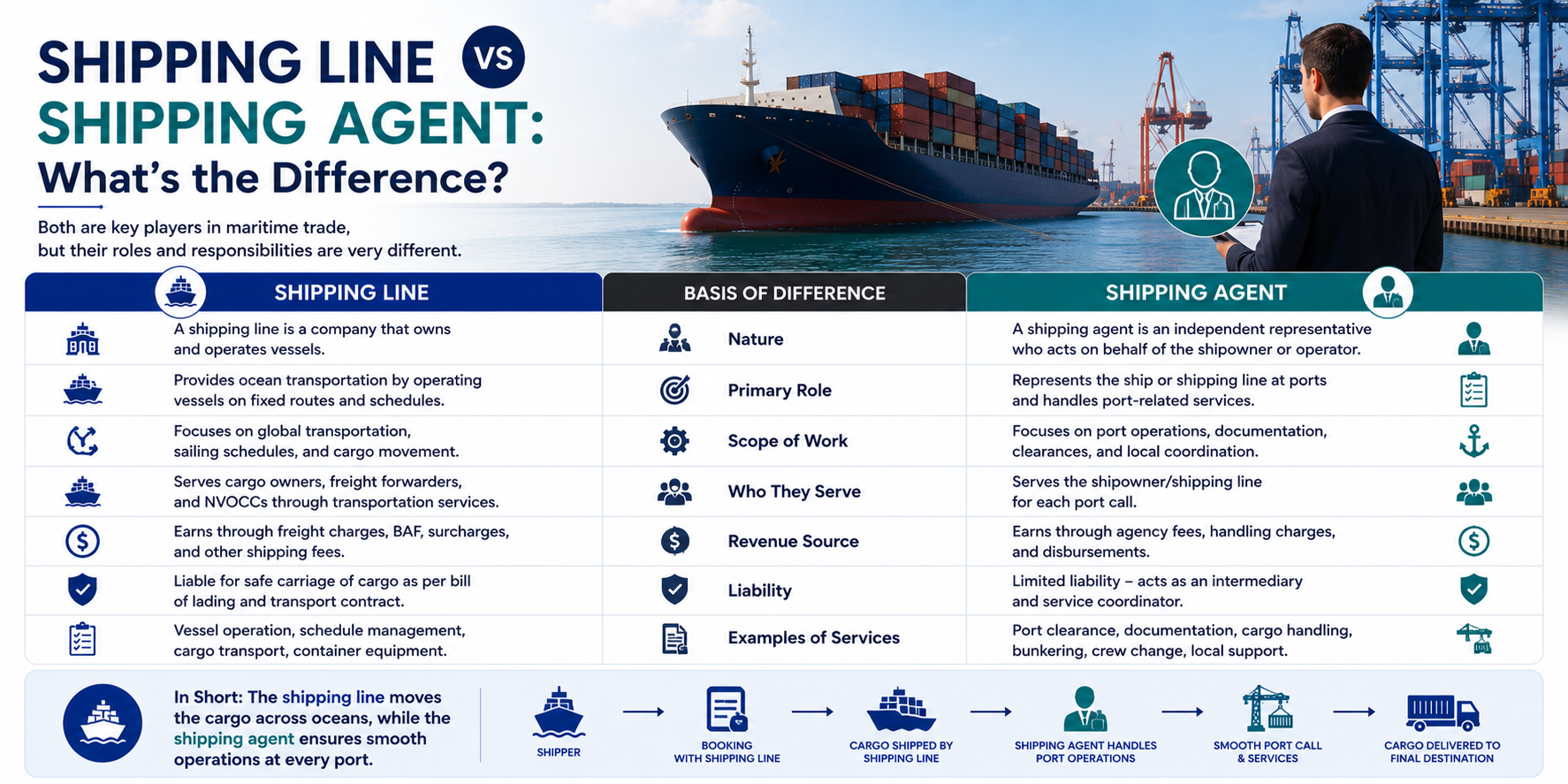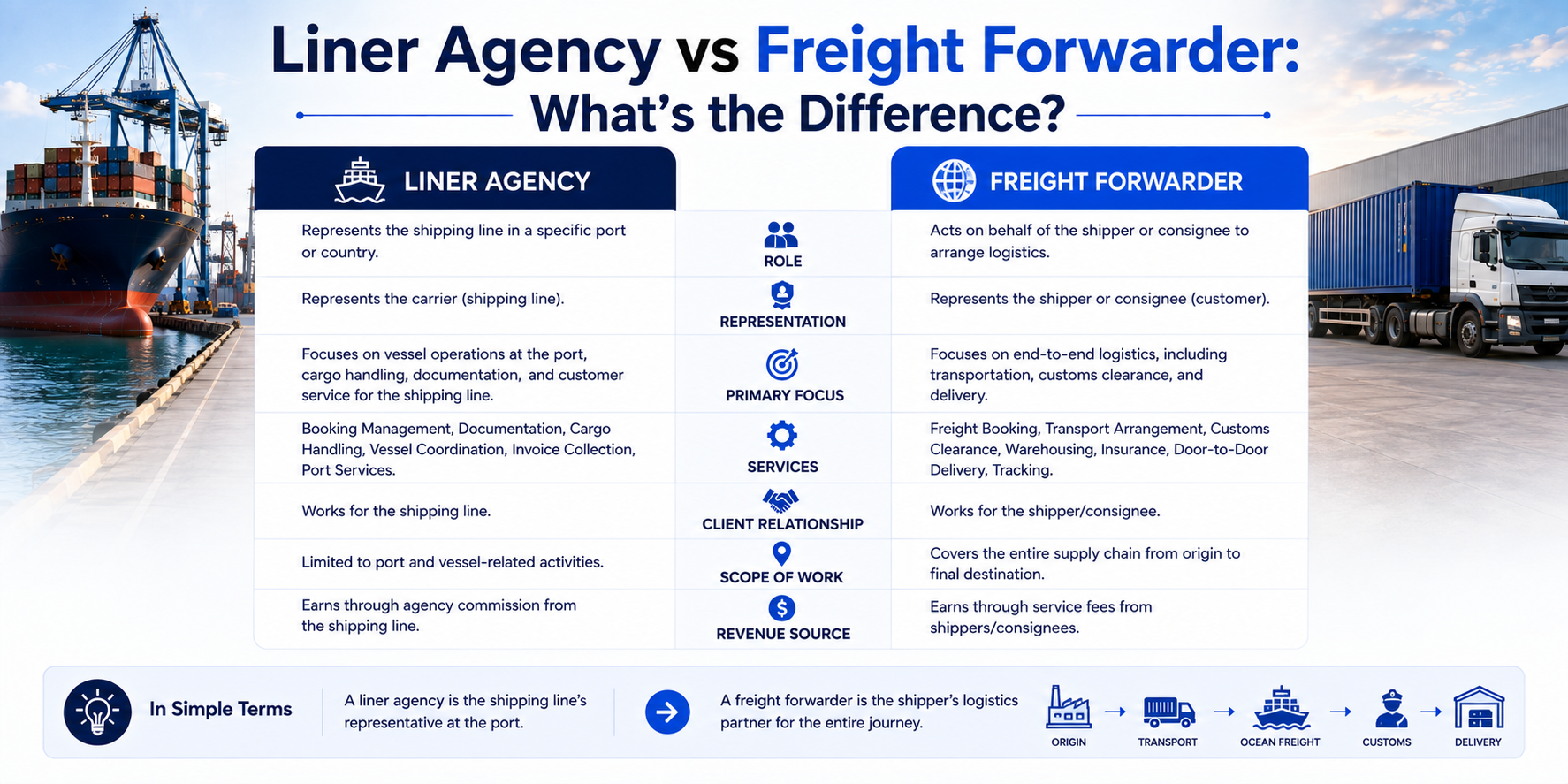
Picking between an NVOCC, a freight forwarder, and a shipping line shouldn’t feel like decoding maritime law. Here’s the clean truth: NVOCCs act as carriers and issue House Bills of Lading (HBLs), freight forwarders orchestrate end-to-end logistics and compliance, and shipping lines (VOCCs) operate the ships. In 2025–2026, with alliance shake-ups and India’s shipbuilding momentum, the choice you make shifts your rate, reliability, and risk. This guide shows exactly who to use, when, and why, with India-specific notes to keep paperwork tight.
What each one actually does
NVOCC (Non-Vessel-Operating Common Carrier)
A common carrier that issues its own HBL and doesn’t operate vessels. In its relationship with the vessel operator, the NVOCC is treated as the shipper—giving it room to blend capacity across carriers and protect your schedule under one HBL.
Freight ForwarderProvides carriage arrangement plus value-added services: consolidation, storage, handling, packing, distribution, documentation, insurance placement, and compliance advisory—structured globally by FIATA Model Rules. Think: one coordinator for multimodal complexity.
Shipping Line (VOCC)Operates the ships, publishes schedules, manages networks/alliances, and issues Master Bills of Lading (MBL). The Maersk–Hapag-Lloyd “Gemini Cooperation” starts 1 February 2025, with a phased network through mid-2025, shaping service design into 2026.
Costs & documents: who issues what (HBL vs MBL), liability, insurance
- Shipping Line (VOCC): Issues MBL; sells spot/contract space. Liability sits with the carrier per carriage rules; you cover cargo via insurance.
- NVOCC: Issues HBL (its own contract of carriage), buys space from VOCCs, and can switch routings/carriers while keeping one document stream. In U.S. trades, NVOCCs must hold FMC license/bond—extra assurance on transportation-related claims.
- Freight Forwarder: Typically arranges transport on a VOCC MBL or NVOCC HBL, while handling docs, customs, consolidation, and other FIATA-aligned services.
Decision matrix: shipment profile → best choice
Shipment profile Pick Why SME LCL with rollover risk NVOCC or a forwarder leveraging strong NVOCCs HBL control + consolidation options reduce rollovers and rebooking pain. Predictable FCL on stable lanes Direct with Shipping Line (VOCC) + forwarder for docs Contracted allocation and predictable free-time; keep forwarder for customs/inland. Time-sensitive lanes with schedule variability NVOCC Ability to shift carriers/routes under one HBL protects transit time. Complex door-to-door / multimodal Freight Forwarder (FIATA-aligned) + NVOCC/VOCC One brain for permits/compliance; blended capacity underneath. ODC / heavy-lift Forwarder with project cargo desk (plus NVOCC/VOCC as needed) Permits, escorts, engineered lashing, special trailers/cranes—beyond standard freight. (Context from your ODC article.)
India-specific note: MTO framework & paperwork touchpoints
In India, much door-to-door ocean logistics sits under the Multimodal Transport Operator (MTO) regime. The Multimodal Transportation of Goods Act, 1993 and DG Shipping prescriptions define the Multimodal Transport Document (MTD) and registration/renewal. Exporters should align BLs/MTDs, insurance, and door terms to avoid claims friction.
Practical takeaway: If your scope is truly multimodal, structure your contract documents (HBL/MBL/MTD), insurance clauses, and delivery obligations to fit MTO requirements before cargo moves.
Red flags & risk controls for 2025–2026
- Alliance reshuffles: The Gemini Cooperation re-wires strings from Feb 2025. Re-validate service maps, transshipment points, and port pairs before locking 12-month contracts.
- Schedule reliability & volatility: Global reliability improved into mid-2025 (Sea-Intelligence GLP; seaexplorer), but remains trade-specific; build buffer days and option lanes.
- India capacity signal: CMA CGM’s LOI with Cochin Shipyard for six LNG-powered feeder container vessels (mid-Oct 2025) is a confidence boost for India’s maritime ecosystem—relevant for medium-term feeder capacity.
How SJ Logistics maps the choice to outcomes
- Qualification call → route/risk scan (lanes, seasonality, equipment, reliability thresholds).
- Matrix carrier mix: NVOCC for flexibility, VOCC contracts for base volume, forwarder controls for compliance/inland.
- HBL/MBL strategy: Lean HBL where control matters (rollovers, variable schedules); anchor MBL contracts for stable FCL.
- SLA & governance: KPIs—on-time performance, rollover rate, free-time utilization, claim ratio, milestone visibility.
- Quarterly resets: Adjust mix as alliances/schedules evolve into 2026.
FAQs
1) Is an NVOCC legally a carrier? Yes. An NVOCC is a common carrier that issues its own HBL and does not operate vessels; toward the VOCC, it is the shipper. 2) Can a freight forwarder issue a bill of lading? A forwarder typically arranges carriage on a VOCC’s MBL or an NVOCC’s HBL, while handling documentation, consolidation, customs, insurance, and advisory under FIATA-aligned terms. 3) When should I go direct to a shipping line? When you have predictable FCL volumes on stable strings and want contract allocation and consistent free-time—still with a forwarder/NVOCC supporting inland and compliance. Re-check 2025–2026 service changes first.
4) Does India’s MTO regime affect my choice? Yes. Align MTD/BL strategy, insurance, and door clauses with the Multimodal Transportation of Goods Act and DG Shipping procedures to reduce claim and liability friction.
Tags- NVOCC
- Freight Forwarder
- Shipping Line
- Shipping Agents
- Liner Agencies
- Shipping Line
- Liner Agencies
- Liner Agencies